Research Article | | Peer-Reviewed

Floral Nectar Secretion Dynamics and Honey Production Potential of Leucas abyssinica (LAMIACEAE)

Received: 31 March 2025     Accepted: 21 April 2025     Published: 24 May 2025
Views:       Downloads:
Abstract

Ethiopia's beekeeping industry benefits immensely from the diverse range of plant species that are supported by the country's ideal environment. However, different plant species produce different amounts of nectar, which has a direct impact on how much honey is produced. Many factors, such as flower shape, flower morphology, flowering phenology, and the amount and quality of nectar produced, affect how much each plant species contributes to the production of honey. The quality and amount of nectar are also greatly influenced by environmental factors such as temperature, humidity, wind speed, and sunlight. Measuring nectar production in relation to these climates parameters is essential. Knowing how much honey each blooming plant species can produce is important for determining how they affect beehive productivity and for guiding management plans for forests and watersheds. Therefore, this study was aimed to quantify the dynamics of nectar secretion and the honey production potential of Leucas abyssinica. To measure the accumulated nectar volume, a set of flowers was enclosed with mesh bags one day before nectar collection. Nectar volume, concentration, temperature, and humidity were recorded at 4-hour intervals. It was adjusted according to the flower size the species. The collected data were analyzed using one-way ANOVA and linear regression. The results showed significant differences (at p < 0.05) in nectar secretion dynamics at various times of the day. The volume of nectar available between consecutive measurements ranged from from 0.78 to 1.04 (µl) per flower. Nectar concentration varied throughout the day, ranging from 30.35% to 36.79%. Temperature and humidity were negatively correlated with nectar volume and concentration. Based on the average nectar sugar content, the mean honey production potential was estimated at 32.2 kg/ha, with a maximum potential of 110 kg/ha. These findings suggest that L. abyssinica have substantial honey production potential. Therefore, promoting the planting and in-situ conservation of this plant species is recommended to support sustainable honey production.

Published in American Journal of Bioscience and Bioengineering (Volume 13, Issue 3)
DOI 10.11648/j.bio.20251303.11
Page(s) 28-34
Creative Commons

This is an Open Access article, distributed under the terms of the Creative Commons Attribution 4.0 International License (http://creativecommons.org/licenses/by/4.0/), which permits unrestricted use, distribution and reproduction in any medium or format, provided the original work is properly cited.

Copyright

Copyright © The Author(s), 2025. Published by Science Publishing Group

Keywords

Concentration, Humidity, Sugar, Temperature, Volume

1. Introduction
Ethiopia's favorable climate supports a wide range of plant species, which greatly benefits the country's beekeeping sector . As noted by honeybees in Ethiopia forage on the majority of flowering plants, collecting nectar and pollen that are essential for their energy and protein needs . However, nectar production varies across plant species, directly influencing the quantity of honey produced. Beekeeping is a vital part of Ethiopia's economy, creating numerous employment opportunities .
Bee plants, as defined by Bareke and Addi , are plant species that provide nectar and/or pollen that are beneficial to honeybees. The honey production potential of a plant is assessed by measuring nectar volume and concentration . Nectar is secreted by plants through specialized structures called nectaries and is primarily composed of sucrose and hexoses, along with small quantities of amino acids, flavonoids, vitamins, and other organic compounds that can influence the foraging behavior and ecology of bees . The contribution of different plant species to honey production is influenced by various factors, including floral shape, flower anatomy, flowering phenology, and the quality and quantity of nectar produced . Environmental conditions, such as temperature, humidity , wind speed, and sunlight ; also play a significant role in determining nectar quality and quantity. Therefore, it is crucial to measure nectar production in relation to these climatic factors .
Understanding the honey production potential of different flowering plant species is key to assessing their impact on beehive productivity and informing forest and watershed management strategies . Given that plants vary in their capacity to produce honey, identifying and categorizing those with the highest production potential is essential .
In Ethiopia, there is still a knowledge gap regarding the nectar secretion dynamics and honey production potential of many bee forage plants. Specifically, there is limited data on the honey production potential of Leucas abyssinica (Benth) Briq which is known to be significant melliferous species . L. abyssinica plant grows in montane bush land, along roadsides, and on degraded mountain slopes at altitudes of 700-1300 to 2600-3000 meters, occurring across most floristic regions, including Eritrea and Somalia. It flowers in September and October, providing nectar and pollen for honeybees during this period . Therefore, the study aims to investigate the nectar secretion patterns and honey the production potential of this plant.
2. Materials and Methods
Nectar volume was determined using a micropipette, while nectar concentration was assessed with a digital refractometer. Temperature and humidity were recorded concurrently with a thermo-hygrometer.
2.1. Study Area
Study locations were chosen based on the accessibility and abundance of Leucas abyssinica (Benth) Briq. This species was selected due to its ecological adaptability, the intensity of honeybee foraging, and its honey production potential. The three-year study took place from 2021 to 2023 in the Negelle Arsi district at three different places.
2.2. Calculating the Proportion of Plants and Flowers in a Given Region
To estimate plant density at each site, ten plots were randomly chosen. Plot site was 2 m by 2 m (4 m2), were selected at random. The number of flowers on each plant was counted individually . A total of 30 plots were designated for this study. This approach was used to estimate both the number of flowers per plant and the number of flowers per unit area.
2.3. Determining the Length of the Nectar Secretion
Nectar secretions, as well as the times of flower opening and closing, were recorded. To determine the duration of nectar secretion, five distinct flowers were measured daily from the beginning to the end of nectar secretion, with this process repeated consistently .
2.4. Measurement of the Nectar's Volume and Nectar Concentration
To prevent insect nectar robbers, inflorescences were covered with fine mesh for 24 hours prior to nectar collection from each flower. Following the method of , flowers from different parts of the inflorescence were labelled randomly. Nectar was harvested every 24 hours from 20 randomly selected flowers each day for three consecutive days, with collections occurring at three-hour intervals
2.5. Determining Dynamics of Nectar Secretion
Nectar volume, nectar concentration, temperature, and humidity were measured daily at the intervals of 4 hours for Leucas abyssinica. Nectar volume was assessed from an average of five separate flowers per plant and sampling period .
2.6. Calculating the Amount of Sugar in Each Flower's Nectar
The amount of sugar present in the nectar was determined based on nectar volume, concentration, and sucrose density. The sucrose density was estimated from the nectar concentration using the Prys-Jones and Corbet equation as follows:
ρ = 0.003729/C + 0.0000178 C2 + 0.9988603
Where:
ρ: The estimate of sucrose density for a given value of C,
C: Nectar concentration (%) (Refractometer reading)
The equation from Dafni was used to determine the amount of sugar per flower.
2.7. Estimation of Sugar and Honey Production Potential (HPP)
The plants' potential for producing honey was assessed to be as follows: Average sugar content per ha = average number of flowers per ha (Minimum to maximum number of flowers per ha) * average sugar content per flower/flowering season . One kg of ripe honey is expected to have an average moisture content of 18% while the sugar content is 82%. Therefore, the honey per ha of the plants= sugar content per ha of the plants divided by 0.82 kg of sugar .
2.8. Data Analysis
One-way ANOVA was used to evaluate the gathered data. For mean separation between the treatments, Tukey Test was utilized. Additionally, a linear regression model was generated using the R programming language to examine how temperature and humidity affect the volume and sugar concentration of nectar.
3. Results and Discussion
3.1. Nectar Secretion Dynamics of Leucas abyssinica
The nectar secretion in volume and concentration had significant variation (p<0.05) for Leucas abyssinica among times of the day. The nectar secretion patterns of Leucas abyssinica show a clear diurnal variation, with the highest volume secreted at 10 hours and the lowest at 18 ours (Table 1). This pattern suggests that the plant may be more attractive to pollinators earlier in the day when the nectar volume is higher, potentially influencing the foraging behavior of pollinators, especially bees. In contrast, while the nectar concentration is at its lowest in the morning, it increases throughout the day, peaking in the late afternoon at 18 hours. This higher concentration could attract pollinators looking for more sugar-rich nectar during the later hours, balancing out the reduced nectar volume.
When compared to other species, L. abyssinica had a lower nectar secretion volume per flower than Hygrophila auriculata (2.5 µl) and Salvia leucantha (5.5 µl) . However, the significantly higher nectar concentration in L. abyssinica (36.79%) compared to Hygrophila auriculata (33%) and Salvia leucantha (31.7%) suggests that pollinators seeking high-sugar nectar could still prefer L. abyssinica, especially in the afternoon. This trade-off between nectar volume and concentration reflects the plant's adaptation to attract different pollinators at varying times of the day, optimizing its pollination success.
The differences in nectar volume and concentration between species may be due to their biological traits, habitat, and evolutionary strategies to attract different pollinators. Leucas abyssinica, with its higher nectar concentration, may rely on fewer but more energy-dense rewards for pollinators compared to species with larger nectar volumes.
Table 1. Mean nectar concentration (%) and volume (µl) per flower of Leucas abyssinica at 2 hours intervals with ± (SE) from 10:00 to18:00 hours in Negele Arsi.

Time (hr)

Volume ± SE (μl)

Concentration (%) ± SE

10:00

1.04 + 0.07a

30.35 + 1.32b

14:00

0.92 + 0.04ab

34.57 + 1.19a

18:00

0.78 + 0.03b

36.79 + 1.15a

Overall Mean

0.92 + 0.03

33.68 + 0.77

3.2. Effects of Temperature on Nectar Volume and Concentration
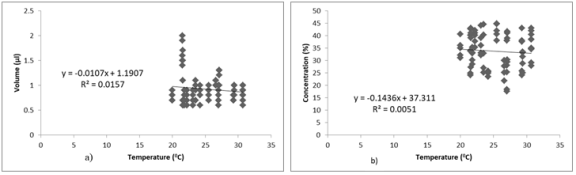
Temperature (°C) showed a negative correlation with both nectar volume and concentration in L. abyssinica (Figure 1a & b). However, the effect of temperature on both nectar volume and concentration was not significant (at R2= 0.0157 and 0.0051, respectively) (Figure 1a & b). The highest nectar volumes were observed at temperatures between 20°C and 25°C, while the highest nectar concentrations were found between 25°C and 30°C.
The data suggests that as temperature increases, both the volume and concentration of nectar produced by L. abyssinica tend to decrease, though this trend is not strong enough to be considered significant. This means that while there may be a visible relationship between temperature and nectar production, it’s possible that other factors or variability in the data may have influenced the results. The highest nectar volumes were recorded at moderate temperatures (20°C to 25°C), while slightly higher temperatures (25°C to 30°C) favoured greater nectar concentration. This suggests that different temperature ranges may optimize nectar traits in different ways.
Figure 1. Effects of temperature on nectar volume (a) and concentration (b) of Leucas abyssinica.
3.3. Effects of Humidity on Nectar Volume and Concentration
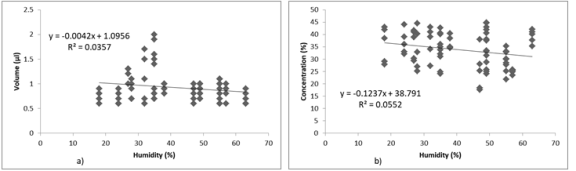
Humidity (%) exhibited a negative correlation with both nectar volume and concentration in L. abyssinica (Figure 2a & b). However, this relationship was not statistically significant, as indicated by the low R² values (R² = 0.0357 for nectar volume and R² = 0.0552 for nectar concentration) (Figure 2a & b). The highest nectar volumes were recorded when humidity ranged between 30% and 40%, while the highest nectar concentrations occurred in a broader humidity range, between 20% and 65%.
While the data suggest that higher humidity may be linked to reduced nectar volume and concentration, the weak correlation (low R² values) indicates that humidity does not strongly predict changes in nectar production in L. abyssinica. Other environmental or biological factors likely play a more significant role. However, it is worth noting that nectar volume tends to peak at moderate humidity levels (30–40%), and nectar concentration remains highest over a wide range of humidity (20–65%), suggesting that L. abyssinica can maintain relatively high nectar quality over a variety of humidity conditions.
Figure 2. Effects of humidity on nectar volume (a) and concentration (b) of Leucas abyssinica.
3.4. Inflorescence and Flower Density of Leucas abyssinica
Leucas abyssinica has a mean of 17.00 ± 2.00 inflorescences per plant, with an average of 2,062.00 ± 203.83 flowers per plant. This translates to 4,124.00 ± 407.32 flowers per square meter and 41,218,462.00 ± 4,073,005.52 flowers per hectare (Table 2). The abundance of inflorescences per plant suggests that each plant produces numerous flowering structures, enhancing its appeal to pollinators. With an average of over two thousand flowers per plant, L. abyssinica serves as a substantial source of floral resources, making it highly attractive to pollinators like bees. It provides flower from the ground to the tip of the plant. On a larger scale, the high density of flowers per square meter and hectare highlights the extensive availability of blooms in a given area. This high floral density benefits bees by reducing their energy expenditure during foraging, making L. abyssinica an efficient food source.
3.5. Nectar Secretion Duration of Leucas abyssinica
The average nectar secretion period for L. abyssinica is 8 ± 0.4 days, with a range of 6 to 9 days. During this period, each flower produces an average nectar volume of 0.78 μl over 24 hours, ranging from 0.6 to 1.2 μl (Table 2). This duration indicates that the flowers of L. abyssinica consistently produce nectar for about a week or longer, providing sustained nectar supply. This range allows for adaptation to varying environmental conditions like temperature and humidity that might influence nectar production. While the individual nectar volume may appear small, the large number of flowers per plant and per hectare results in substantial cumulative nectar production, offering a plentiful resource for nectar-feeding insects such as honeybees.
Table 2. Mean number of inflorescences per plant (IPP), flowers per inflorescences (FPI), flower per plant (FPP) and flowers per hectare (FPH), Nectar volume (μl)/24 hours and Nectar secretion length (Day) ± standard error (SE) for Leucas abyssinica Negelle Arsi district.

Parameters

Mean + SE

Minimum

Maximum

Inflorescences per plant

17.00 + 2.00

8.00

42.00

Flowers per plant

2062.00 + 203.83

238.00

2720.00

Flowers/m2

4124.00 + 407.32

952.00

10880.00

Flowers per ha

41,218,462.00 + 4073005.52

9520,000.00

108,800,000.00

Nectar volume (μl)/24 hours

0.78 + 0.04

0.60

1.20

Nectar secretion length (Day)

8 + 0.40

6.00

9.00

3.6. Sugar and Honey Production Potential of Leucas abyssinica
The mean sugar content per flower was found to be 0.32 mg ± 0.01, while the mean honey production per flower reached 0.39 mg ± 0.02 (Table 3). This indicates that each flower of L. abyssinica contributes a small yet valuable amount of sugar and honey, with honey yield being slightly higher than the sugar content per flower. This is because the size of the flower of L. abyssinica is very small. Such data is crucial for understanding the flower's attractiveness to honeybees, which prefer plants that offer higher nectar yields, translating into increased honey production.
On a per-plant basis, the sugar yield was measured at 0.66 g ± 0.02, while the honey yield reached 0.80 g ± 0.04 (Table 3). These findings suggest that each individual plant of L. abyssinica produces a modest quantity of sugar and honey, reinforcing the plant’s potential as a source of nectar for bees. The slightly higher honey yield per plant points to the efficiency with which nectar is collected and processed by pollinators such as honeybees.
When scaled to a hectare level, the potential becomes more pronounced. The mean sugar yield per hectare was 26.2 kg ± 0.82, while the mean honey yield per hectare was 32.2 kg ± 1.00, with values ranging from 1.3 to 110 kg/ha (Table 3). This range highlights the significant variability in honey production, which can be attributed to factors such as plant age and density, soil conditions, rainfall, and the overall productivity of flowers. Such variation is consistent with previous studies on nectar secretion rates and honey production potential across different plant species , where environmental conditions, plant species, age of the plants and life forms of the plants have been shown to influence nectar yield significantly.
The higher average honey yield compared to sugar content suggests that nectar from L. abyssinica is efficiently converted into honey by honeybees, making it a valuable resource for beekeepers. This observation aligns with findings in other studies, such as the work by Bareke and colleagues on Coffea arabica, which demonstrated how the nectar yield per flower directly correlates with the honey production capacity per hectare . The ability of a plant species to produce a stable supply of nectar throughout its flowering period directly impacts the honey yields and, by extension, the economic potential of beekeeping in a given area.
Understanding these metrics helps inform decisions in agriculture, beekeeping, and conservation, especially in regions where L. abyssinica is native or cultivated. The variability in per-hectare production emphasizes the role of local environmental conditions and agricultural practices in optimizing yield. Consequently, targeted management practices, such as adjusting planting density and improving soil conditions, could help maximize the honey production potential of L. abyssinica. Moreover, recognizing the plant's role in supporting pollinator populations contributes to broader conservation efforts aimed at maintaining biodiversity and sustaining ecological services like pollination.
Table 3. Mean sugar (mg)/flower, honey (mg)/flower, sugar (g)/plant, honey (g)/plant, sugar (kg)/ha and Honey (kg)/ha ± standard error (SE) for Leucas abyssinica in Negelle Arsi district.

Parameters

Mean ± SE

Minimum

Maximum

Sugar (mg)/flower

0.32 + 0.01

0.11

0.82

Honey (mg)/flower

0.39 + 0.02

0.13

1.01

Sugar (g)/plant

0.66 + 0.02

0.03

2.23

Honey (g)/plant

0.80 + 0.04

0.03

2.75

Sugar (kg)/ha

26.4 + 0.82

1.04

89.20

Honey (kg)/ha

32.2 + 1.00

1.30

110.00

4. Conclusion
From this study, Leucas abyssinica is a sufficient producer of nectar and significantly contributes to honey production. Temperature and humidity were negatively correlated with nectar volume and concentration. The amount of nectar volume and concentration varied at different times of the day. The mean honey production potential of Leucas abyssinica was estimated at 32.2 kg/ha, with a maximum potential of 110 kg/ha. Based on the dynamics and quantities of nectar secreted per flower and per plant, the species is a promising honey source plant for the study area. This species is valuable as a honey source and for its ecological contributions. Therefore, further research on propagation methods and in-situ conservation is recommended to ensure sustainable honey production. To increase honey production without adversely influencing the production capacity of individual colonies, honey production potential should also be determined for other important bee food plants.
Abbreviations

ANOVA

Analysis of Variance

IPP

Inflorescences per Plant

FPI

Flowers per Inflorescences

FPP

Flower per Plant

FPH

Flowers per Hectare

SE

Standard Error

Acknowledgments
We acknowledge the Holeta Bee Research Center and Oromia Agricultural Research Institute for providing the required facilities and logistics. The authors' sincere thanks are also extended to Mr. Tesfaye Abera and our driver Bekele Gemechu for helping us during field data collection. This research was supported by Oromia Agricultural Research Institute, Ethiopian Government Fund.
Author Contributions
Shimu Debela Lema: Formal Analysis, Investigation, Writing – original draft, Writing – review & editing
Tura Bareke: Conceptualization, Investigation, Data curation, Formal Analysis, Methodology, Software, Visualization, Writing – original draft
Admassu Addi: Data curation, Supervision
Conflicts of Interest
The authors declare no conflicts of interest.
References
[1] Fichtl, R. and A. Adi, Honeybee flora of Ethiopia. 1994.
[2] Adi, A., et al., Honeybee forages of Ethiopia. Holeta Bee Research Center, Addis Ababa, Ethiopia, 2014.
[3] Obeng-Darko, S. A., et al., Dihydroxyacetone in the floral nectar of Ericomyrtus serpyllifolia (Turcz.) Rye (Myrtaceae) and Verticordia chrysantha Endl. (Myrtaceae) demonstrates that this precursor to bioactive honey is not restricted to the genus Leptospermum (Myrtaceae). Journal of Agricultural and Food Chemistry, 2023. 71(20): p. 7703-7709.
[4] Abro, Z., et al., The impact of beekeeping on household income: evidence from north-western Ethiopia. Heliyon, 2022. 8(5).
[5] Bareke, T. and A. Addi, Bee flora resources and honey production calendar of Gera Forest in Ethiopia. Asian Journal of Forestry, 2019. 3(2).
[6] Bareke, T., T. Kumsa, and A. Addi, Nectar secretion and honey production potential of Schefflera abyssinica (Hochst. ex A. Rich.) Harms, Araliaceae. Tropical Agriculture, 2020. 97(3).
[7] Galetto, L. and G. Bernardello, Floral nectaries, nectar production dynamics and chemical composition in six Ipomoea species (Convolvulaceae) in relation to pollinators. Annals of botany, 2004. 94(2): p. 269-280.
[8] Bertazzini, M. and G. Forlani, Intraspecific variability of floral nectar volume and composition in rapeseed (Brassica napus L. var. oleifera). Frontiers in plant science, 2016. 7: p. 288.
[9] Alqarni, A. S., A. M. Awad, and A. A. Owayss, Evaluation of Acacia gerrardii Benth. (Fabaceae: Mimosoideae) as a honey plant under extremely hot-dry conditions: flowering phenology, nectar yield and honey potentiality. 2015.
[10] Bareke, T., et al., Dynamics of nectar secretion, honey production potential and colony carrying capacity of Coffea arabica L., Rubiaceae. Journal of Agriculture and Environment for International Development (JAEID), 2021. 115(1): p. 125-138.
[11] Dafni, A., Pollination ecology: a practical approach. 1992.
[12] Bareke, T. and A. Addi, Quantifying nectar secretion potential of Hygrophila auriculata (Schum.), Heine (Acanthaceae), and Salvia leucantha Cav. (Lamiaceae) for honey production. Advances in Agriculture, 2022. 2022(1): p. 8301903.
[13] Adgaba, N., et al., Nectar secretion dynamics and honey production potentials of some major honey plants in Saudi Arabia. Saudi Journal of Biological Sciences, 2017. 24(1): p. 180-191.
[14] Wyatt, R., S. B. Broyles, and G. S. Derda, Environmental influences on nectar production in milkweeds (Asclepias syriaca and A. exaltata). American Journal of Botany, 1992. 79(6): p. 636-642.
[15] Esteves, R. J. P., M. C. Villadelrey, and J. F. Rabajante, Determining the optimal distribution of bee colony locations to avoid overpopulation using mixed integer programming. Journal of Nature Studies, 2010. 9(1): p. 79-82.
[16] Prys-Jones, O. and S. Corbet, Naturalists’ Handbooks 6: Bumblebees. Slough: Richmond Publishing Co. Ltd, 1991.
[17] Kim, S.-H., et al., Analysis of floral nectar characteristics of Korean and Chinese hawthorns (Crataegus pinnatifida Bunge). Journal of Apicultural Research, 2018. 57(1): p. 119-128.
[18] BAREKE, T. and A. ADDI, Floral nectar secretion dynamics of Pavonia Urens (Malvaceae) and honey production potential. Nusantara Bioscience, 2024. 16(1).
Cite This Article
  • APA Style

    Lema, S. D., Bareke, T., Addi, A. (2025). Floral Nectar Secretion Dynamics and Honey Production Potential of Leucas abyssinica (LAMIACEAE). American Journal of Bioscience and Bioengineering, 13(3), 28-34. https://doi.org/10.11648/j.bio.20251303.11

    Copy | Download

    ACS Style

    Lema, S. D.; Bareke, T.; Addi, A. Floral Nectar Secretion Dynamics and Honey Production Potential of Leucas abyssinica (LAMIACEAE). Am. J. BioSci. Bioeng. 2025, 13(3), 28-34. doi: 10.11648/j.bio.20251303.11

    Copy | Download

    AMA Style

    Lema SD, Bareke T, Addi A. Floral Nectar Secretion Dynamics and Honey Production Potential of Leucas abyssinica (LAMIACEAE). Am J BioSci Bioeng. 2025;13(3):28-34. doi: 10.11648/j.bio.20251303.11

    Copy | Download

  • @article{10.11648/j.bio.20251303.11,
      author = {Shimu Debela Lema and Tura Bareke and Admassu Addi},
      title = {Floral Nectar Secretion Dynamics and Honey Production Potential of Leucas abyssinica (LAMIACEAE)
    },
      journal = {American Journal of Bioscience and Bioengineering},
      volume = {13},
      number = {3},
      pages = {28-34},
      doi = {10.11648/j.bio.20251303.11},
      url = {https://doi.org/10.11648/j.bio.20251303.11},
      eprint = {https://article.sciencepublishinggroup.com/pdf/10.11648.j.bio.20251303.11},
      abstract = {Ethiopia's beekeeping industry benefits immensely from the diverse range of plant species that are supported by the country's ideal environment. However, different plant species produce different amounts of nectar, which has a direct impact on how much honey is produced. Many factors, such as flower shape, flower morphology, flowering phenology, and the amount and quality of nectar produced, affect how much each plant species contributes to the production of honey. The quality and amount of nectar are also greatly influenced by environmental factors such as temperature, humidity, wind speed, and sunlight. Measuring nectar production in relation to these climates parameters is essential. Knowing how much honey each blooming plant species can produce is important for determining how they affect beehive productivity and for guiding management plans for forests and watersheds. Therefore, this study was aimed to quantify the dynamics of nectar secretion and the honey production potential of Leucas abyssinica. To measure the accumulated nectar volume, a set of flowers was enclosed with mesh bags one day before nectar collection. Nectar volume, concentration, temperature, and humidity were recorded at 4-hour intervals. It was adjusted according to the flower size the species. The collected data were analyzed using one-way ANOVA and linear regression. The results showed significant differences (at p < 0.05) in nectar secretion dynamics at various times of the day. The volume of nectar available between consecutive measurements ranged from from 0.78 to 1.04 (µl) per flower. Nectar concentration varied throughout the day, ranging from 30.35% to 36.79%. Temperature and humidity were negatively correlated with nectar volume and concentration. Based on the average nectar sugar content, the mean honey production potential was estimated at 32.2 kg/ha, with a maximum potential of 110 kg/ha. These findings suggest that L. abyssinica have substantial honey production potential. Therefore, promoting the planting and in-situ conservation of this plant species is recommended to support sustainable honey production.
    },
     year = {2025}
    }
    

    Copy | Download

  • TY  - JOUR
    T1  - Floral Nectar Secretion Dynamics and Honey Production Potential of Leucas abyssinica (LAMIACEAE)
    
    AU  - Shimu Debela Lema
    AU  - Tura Bareke
    AU  - Admassu Addi
    Y1  - 2025/05/24
    PY  - 2025
    N1  - https://doi.org/10.11648/j.bio.20251303.11
    DO  - 10.11648/j.bio.20251303.11
    T2  - American Journal of Bioscience and Bioengineering
    JF  - American Journal of Bioscience and Bioengineering
    JO  - American Journal of Bioscience and Bioengineering
    SP  - 28
    EP  - 34
    PB  - Science Publishing Group
    SN  - 2328-5893
    UR  - https://doi.org/10.11648/j.bio.20251303.11
    AB  - Ethiopia's beekeeping industry benefits immensely from the diverse range of plant species that are supported by the country's ideal environment. However, different plant species produce different amounts of nectar, which has a direct impact on how much honey is produced. Many factors, such as flower shape, flower morphology, flowering phenology, and the amount and quality of nectar produced, affect how much each plant species contributes to the production of honey. The quality and amount of nectar are also greatly influenced by environmental factors such as temperature, humidity, wind speed, and sunlight. Measuring nectar production in relation to these climates parameters is essential. Knowing how much honey each blooming plant species can produce is important for determining how they affect beehive productivity and for guiding management plans for forests and watersheds. Therefore, this study was aimed to quantify the dynamics of nectar secretion and the honey production potential of Leucas abyssinica. To measure the accumulated nectar volume, a set of flowers was enclosed with mesh bags one day before nectar collection. Nectar volume, concentration, temperature, and humidity were recorded at 4-hour intervals. It was adjusted according to the flower size the species. The collected data were analyzed using one-way ANOVA and linear regression. The results showed significant differences (at p < 0.05) in nectar secretion dynamics at various times of the day. The volume of nectar available between consecutive measurements ranged from from 0.78 to 1.04 (µl) per flower. Nectar concentration varied throughout the day, ranging from 30.35% to 36.79%. Temperature and humidity were negatively correlated with nectar volume and concentration. Based on the average nectar sugar content, the mean honey production potential was estimated at 32.2 kg/ha, with a maximum potential of 110 kg/ha. These findings suggest that L. abyssinica have substantial honey production potential. Therefore, promoting the planting and in-situ conservation of this plant species is recommended to support sustainable honey production.
    
    VL  - 13
    IS  - 3
    ER  - 

    Copy | Download

Author Information
  • Oromia Agricultural Research Institute, Holeta Bee Research Center, Holeta, Ethiopia

  • Oromia Agricultural Research Institute, Holeta Bee Research Center, Holeta, Ethiopia

  • Oromia Agricultural Research Institute, Holeta Bee Research Center, Holeta, Ethiopia

  • Abstract
  • Keywords
  • Document Sections

    1. 1. Introduction
    2. 2. Materials and Methods
    3. 3. Results and Discussion
    4. 4. Conclusion
    Show Full Outline
  • Abbreviations
  • Acknowledgments
  • Author Contributions
  • Conflicts of Interest
  • References
  • Cite This Article
  • Author Information